 Sreeraam
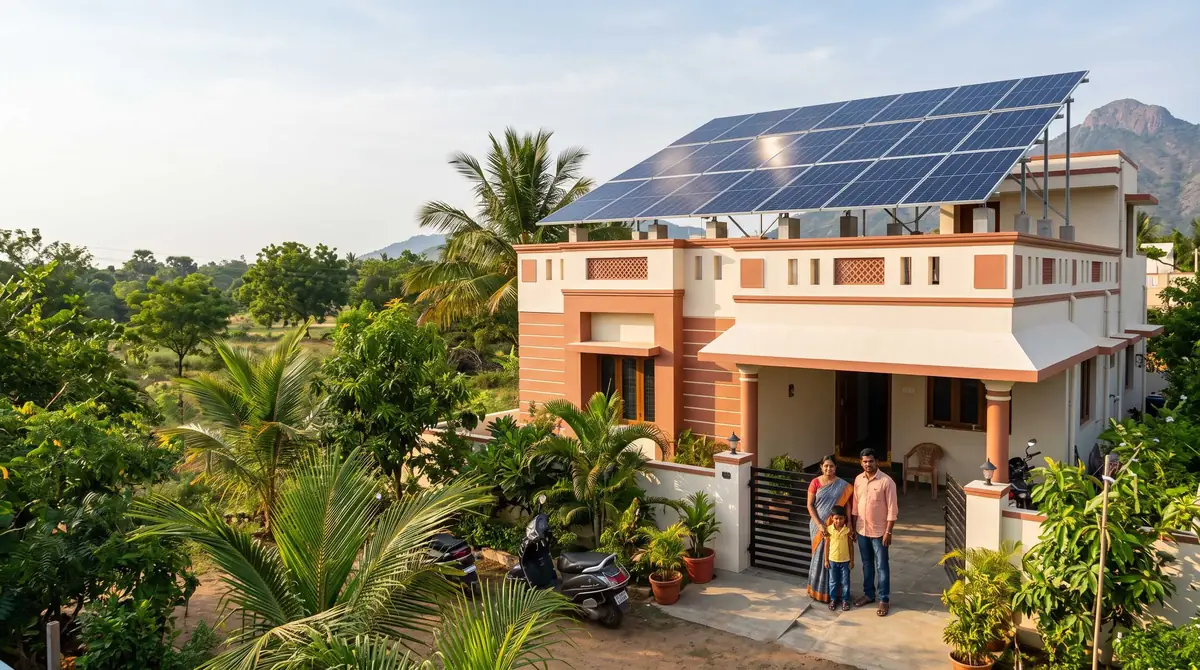
What is PM Surya Ghar: Muft Bijli Yojana?
PM Surya Ghar: Muft Bijli Yojana was launched by the Prime Minister on 13 February 2024. On 29 February 2024 the Union Cabinet approved it with a total outlay of ₹75,021 crore, to install rooftop solar and provide free electricity up to 300 units every month for one crore households.
Through the scheme, households can cut their electricity bills by generating their own power on the rooftop. The scheme is run by the Ministry of New and Renewable Energy (MNRE) and applications are made on the national portal, pmsuryaghar.gov.in.
Central subsidy: how much will you get?
The Central Financial Assistance (CFA) is 60% of the system cost for a 2 kW system, plus 40% of the additional cost for the third kilowatt. It is capped at 3 kW. Amounts below are at current benchmark prices.
| System size | Central subsidy |
|---|---|
| 1 kW | ₹30,000 |
| 2 kW | ₹60,000 |
| 3 kW or higher | ₹78,000 (maximum) |
Extra from the Tamil Nadu government: up to ₹1 lakh in total
Homes in Tamil Nadu get a state top-up on top of the central subsidy. Both are paid by direct bank transfer. These figures are from the official Tamil Nadu Solar Roof Top Portal (TNGECL / TEDA).
| System | Central | TN State | Total |
|---|---|---|---|
| 1 kW | ₹30,000 | ₹5,000 | ₹35,000 |
| 2 kW | ₹60,000 | ₹10,000 | ₹70,000 |
| 3 kW + | ₹78,000 | ₹22,000 | ₹1,00,000 |
Conditions for the state top-up
- Residential rooftop systems up to 10 kW. The subsidy stops increasing at 3 kW.
- Registered on the PM Surya Ghar portal after 5 August 2026.
- Installed by a TEDA-empanelled vendor using DCR-compliant, ALMM-listed solar modules.
- Paid after installation, net metering, commissioning and the central subsidy credit, and once eligibility is verified. The portal says it is credited within 7–15 days of TEDA verification.
- No second application. Once the central subsidy is credited, the state portal takes over automatically, though you may need to upload documents such as the net-meter agreement and plant photos.
What the scheme offers a household
Lower electricity bills
Your rooftop system generates power during the day, reducing what you draw from the grid. The scheme targets up to 300 free units a month.
Extra support in Tamil Nadu
The Tamil Nadu government adds a state top-up of up to ₹22,000 on top of the central subsidy. See the details.
Collateral-free, low-interest loans
Households can access low-interest loans, with interest rates around 6%, for residential systems up to 3 kW, with no collateral. Check the current rate with your bank.
Enough power for a typical home
A 3 kW system generates more than 300 units a month on average, according to the Government of India.
The central scheme also supports a Model Solar Village in every district, incentives for Urban Local Bodies and Panchayati Raj Institutions, and payment security for RESCO-based models.
Who can apply?
The scheme is for residential households. In general you should have the following. Final eligibility is confirmed on the national portal and by TNPDCL (TANGEDCO).
- A residential home in India that you own, with a roof suitable for solar panels (enough shadow-free space).
- A valid electricity connection in the household, with your consumer number from your electricity bill.
- A bank account in your name, because the subsidy is paid directly to it.
- No earlier solar subsidy taken for the same rooftop.
- For the Tamil Nadu top-up: see the extra conditions above (portal registration after 5 August 2026, TEDA-empanelled vendor, ALMM-listed modules).
What to keep ready
Requirements can vary slightly by TNPDCL (TANGEDCO), but these are commonly needed:
- Your latest electricity bill (for the consumer number).
- Aadhaar and identity details; your bank account should be linked as required for direct subsidy payment.
- Proof of address / ownership of the house or roof.
- Bank account details and a cancelled cheque, uploaded after commissioning to receive the subsidy.
- For the Tamil Nadu top-up: net-meter agreement, plant photos and module (DCR) details, uploaded on the state portal. We prepare these for you.
The application process, step by step
Steps marked in green are the ones we take off your hands.
Register on the National Portal
Go to pmsuryaghar.gov.in and register with your state, electricity board (select TNPDCL (TANGEDCO); the portal lists it as the "DISCOM"), electricity consumer number, mobile number and email.
✓ Sreeraam Solar handles thisLog in and apply for rooftop solar
Use your consumer number and mobile number to log in and submit the rooftop solar application.
✓ Sreeraam Solar handles thisAutomatic feasibility approval
Feasibility approval from TNPDCL (TANGEDCO) for your rooftop solar application is automatic, so there is no waiting period at this stage. Once it is approved, we schedule your installation.
Get the system installed by a registered vendor
The portal lets you choose your vendor. We design the system for your roof and install it with ALMM-approved panels.
✓ Sreeraam Solar handles thisSubmit plant details and apply for the net meter
Once installation is complete, the plant details are submitted on the portal and the net meter is applied for.
✓ Sreeraam Solar handles thisInspection and commissioning certificate
After TNPDCL (TANGEDCO) installs the net meter and inspects the system, a commissioning certificate is generated on the portal.
Submit bank details and receive the central subsidy
Upload your bank account details and a cancelled cheque on the portal. The central subsidy is credited directly to your bank account, within about 30 days of submitting these details.
✓ Sreeraam Solar handles thisReceive the Tamil Nadu state top-up
Once your central subsidy is credited, the Tamil Nadu Solar Roof Top Portal picks up your application automatically, with no second application. TEDA verifies eligibility, commissioning and bank details, then credits the state top-up directly to your bank account. You may be asked to upload your net-meter agreement, plant photos and module (DCR) details.
✓ Sreeraam Solar handles thisPM Surya Ghar: your questions answered
Is the solar system free under PM Surya Ghar?
No. You pay your installer for the system, and the subsidy is credited to your bank account after your system is installed, inspected and commissioned. "Muft Bijli" means free electricity from your own solar generation, not a free system.
How much subsidy do I get for a 3 kW system in Tamil Nadu?
A 3 kW system gets ₹78,000 from the central PM Surya Ghar scheme plus ₹22,000 from the Tamil Nadu state top-up, up to ₹1,00,000 in total. Both amounts are capped at 3 kW, so a bigger system does not increase the subsidy. The central amount is calculated at benchmark prices.
Do I need to apply separately for the Tamil Nadu state subsidy?
According to the official Tamil Nadu Solar Roof Top Portal, no second application is needed for the state top-up. Once your central subsidy is credited, the state portal picks up your application automatically and TEDA verifies it. You may be asked to upload documents such as the net-meter agreement and plant photos, which we help you with.
Which installers and solar panels qualify for the Tamil Nadu top-up?
The state subsidy requires a TEDA-empanelled vendor and DCR-compliant, ALMM-listed solar modules. It covers residential rooftop systems up to 10 kW, for applications registered on the PM Surya Ghar portal after 5 August 2026.
Will I really get 300 units of free electricity every month?
The scheme's aim is up to 300 units of free electricity per month for households. According to the Government of India, a 3 kW system generates more than 300 units a month on average. Your actual savings depend on your usage, roof, sunlight and TNPDCL (TANGEDCO) tariff rules, so we calculate your real numbers during the free site visit.
Can I get a loan to install rooftop solar?
Yes. Households can access collateral-free, low-interest loans for residential rooftop systems up to 3 kW, with interest rates around 6%. Terms are set by the lending bank, so check the current rate with your bank before you apply.
Do I have to apply myself, or can the installer do it?
Applications are made through the National Portal, where you also select your vendor. Sreeraam Solar can handle the registration, documentation and follow-up on your behalf as part of our service, so you don't have to chase paperwork.
How long does the whole process take?
Physical installation is usually done in 1–2 days. The full process, including inspection and net metering, typically takes a few weeks depending on the workload of TNPDCL (TANGEDCO). The central subsidy is credited within about 30 days of submitting your bank details on the portal, and the Tamil Nadu top-up follows after TEDA verification (the state portal says within 7–15 days).
Can a shop, business or farm use this subsidy?
PM Surya Ghar and the Tamil Nadu top-up are residential schemes for households. If your property is commercial or agricultural, we will explain the options during the free site visit.
Sources & disclaimer
- Press Information Bureau, Government of India: Cabinet approves PM-Surya Ghar: Muft Bijli Yojana (29 February 2024). Central subsidy amounts, outlay and benefits are from this release.
- Tamil Nadu Solar Roof Top Portal (TNGECL / TEDA): tnebltd.gov.in/usrp. State top-up amounts, conditions and process are from this portal.
- National scheme portal: pmsuryaghar.gov.in for registration and the latest application steps.
- Official helplines: PM Surya Ghar 15555 or 1800-180-3333; TNPDCL (TANGEDCO) Minnagam 1912.
Sreeraam Solar Energy is a private rooftop solar installer. This page is an independent guide and is not an official government website. Subsidy amounts, loan rates and eligibility are set by the government and banks, can change, and approval rests with the government and the electricity board. Page last reviewed October 2026.
Find out exactly what you can claim
Book a free site visit. We check your roof and eligibility, size the right system, and show you your real numbers before you commit.